
Development and Reproduction
Developmental & Reproductive Epigenetics
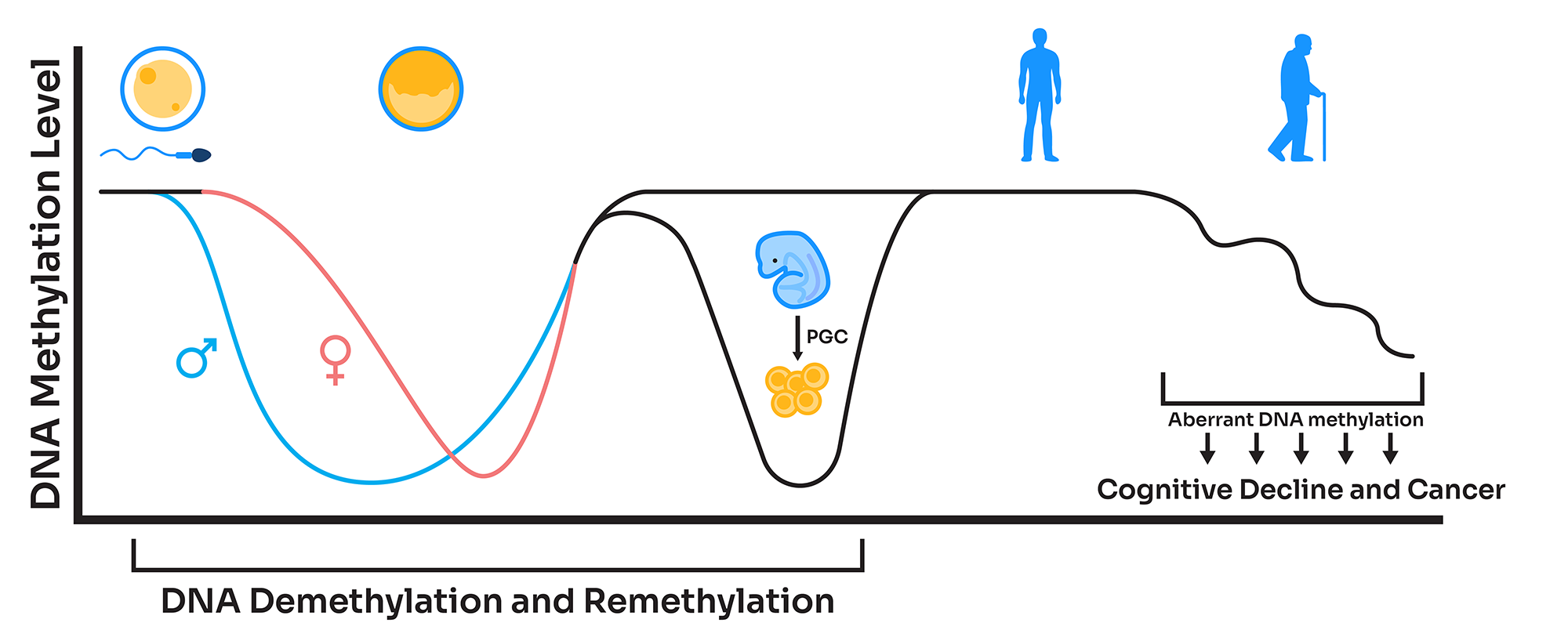
DNA methylation undergoes dramatic reprogramming during early development and in germ cells. These dynamic changes are essential for proper embryonic development, cell differentiation, and germline function.
DNA Methylation in Early Development
Two major epigenetic reprogramming events occur in mammals:
- Post-fertilization (Zygote Stage): Global demethylation occurs in the paternal pronucleus, erasing paternally-inherited methylation marks while maintaining maternal imprints. This produces the lowest methylation levels (~10%) in the early embryo.
- Primordial Germ Cell (PGC) Stage: Complete erasure of parental methylation patterns (genome-wide methylation drops to ~5%) allows resetting of imprints. This is essential for removing epigenetic “memory” from the previous generation.
Molecular Mechanisms
Methylation changes are orchestrated by key enzymes:
- TET Enzymes (TET1, TET2, TET3) (DNA demethylation): Convert 5-methylcytosine to 5-hydroxymethylcytosine
- DNMT3A/3B (De novo methylation): Establish new methylation patterns during somatic differentiation
- DNMT1 (Maintenance methylation): Preserve methylation patterns during DNA replication
Imprinting Disorders
Aberrant methylation can cause imprinting disorders where parent-of-origin-specific methylation patterns are disrupted:
- Prader-Willi Syndrome (PWS) (Chromosome 15q11-q13): Caused by Paternal deletion or maternal uniparental disomy
- Angelman Syndrome (AS) (Chromosome 15q11-q13): Caused by Maternal deletion or paternal uniparental disomy
- Beckwith-Wiedemann Syndrome (BWS) (Chromosome 11p15.5): Caused by Aberrant methylation of H19/IGF2 imprinting region
Ellis Bio SuperMethyl™ Kits for Developmental Research
SuperMethyl™ Max Kit – For Precision Imprinting Analysis
Complete and sequence bias-free C-to-T conversion allows reliable detection of parent-of-origin-specific methylation patterns essential for imprinting disorder diagnosis. Reproducible C-to-T conversion and high-yield recovery enable confident comparison of methylation profiles across developmental stages. Simple and fast workflow fully compatible with NGS and DNA methylation processing pipelines. Best For: Stem cell research, imprinting disorder diagnosis, and developmental trajectory studies requiring maximum fidelity.
References
- Smith ZD, Hetzel S, Meissner A. DNA methylation in mammalian development and disease. Nat Rev Genet. doi: 10.1038/s41576-024-00760-8.
- Wilkinson AL, Zorzan I, Rugg-Gunn PJ. Epigenetic regulation of early human embryo development. Cell Stem Cell. doi: 10.1016/j.stem.2023.09.010.
- Greeson KW, Crow KMS, Edenfield RC, et al. Inheritance of paternal lifestyles and exposures through sperm DNA methylation. Nat Rev Urol., 2023. doi: 10.1038/s41585-022-00708-9.