
Cancer
Cancer Detection, Cancer Diagnosis, & Disease Monitoring via DNA Methylation
Overview: DNA methylation patterns in circulating cell-free DNA (cfDNA) enable non-invasive cancer detection. Methylated DNA biomarkers are increasingly used in liquid biopsy applications for early cancer detection, minimal residual disease (MRD) monitoring, and treatment response assessment. This approach offers significant advantages over traditional screening methods by detecting cancer at earlier stages when treatment outcomes are optimal.
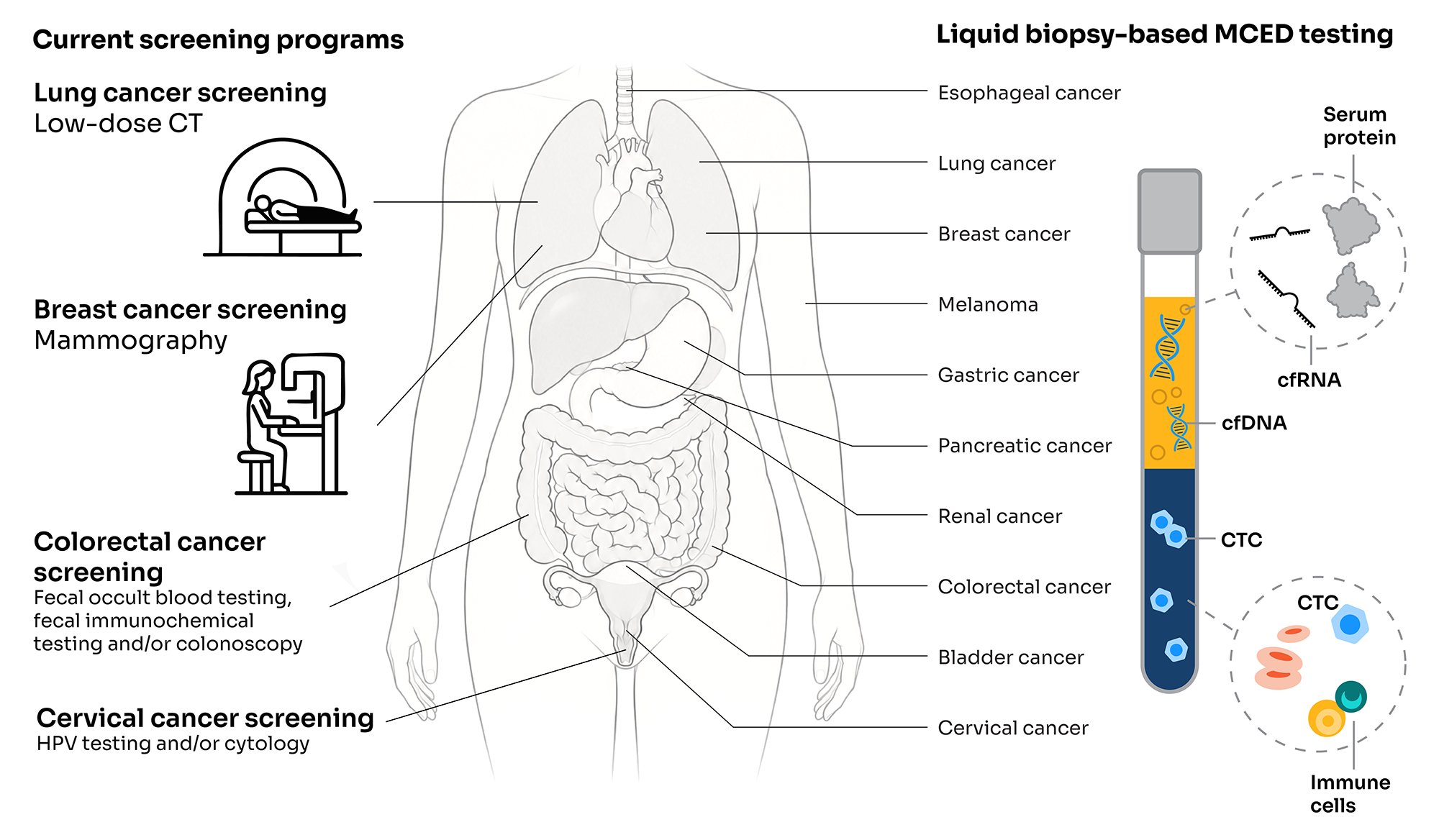
Current Screening Approaches
Traditional cancer screening relies on organ-specific methods with varying sensitivity and specificity. Multi-cancer early detection (MCED) through methylation analysis represents a paradigm shift toward unified, blood-based screening.
- Lung Cancer Screening: Low-dose CT imaging; primarily used in high-risk populations
- Breast Cancer Screening: Mammography with variable performance based on tissue density
- Colorectal Cancer Screening: Fecal occult blood testing (FIT), colonoscopy, or sigmoidoscopy
- Cervical Cancer Screening: HPV testing and cytology; highly effective when combined
Methylation Markers in Cancer Detection
Specific CpG sites exhibit altered methylation patterns in cancer-derived cfDNA. Key markers include:
- MGMT (O-6-methylguanine-DNA methyltransferase): Primary marker for glioblastoma detection; associated with treatment response
- SEPT9 (Septin 9): Well-established marker for colorectal cancer; FDA-approved assay
- SHOX2 & RASSF1A (particularly for lung cancer): Established primarily for lung cancer detection; part of LungMe® assay panel.
Liquid Biopsy-Based Multi-Cancer Early Detection (MCED)
MCED tests leverage methylation signatures to simultaneously screen for multiple cancer types from a single blood sample. This approach improves clinical outcomes by enabling:
- Early detection at stages I-II when treatment is most effective
- Reduced false-positive rates compared to single-cancer biomarkers
- Personalized surveillance strategies based on detected cancer signals
- Easier patient compliance through non-invasive blood testing
Key MCED Examples
Galleri® (GRAIL): Multi-cancer detection test based on cfDNA methylation patterns. CLIA-certified and clinically validated. Detects oesophageal, gastric, lung, breast, melanoma, pancreatic, renal, bladder, and cervical cancers.
Guardant Reveal™ (Guardant Health): Combines methylation analysis with genomic alterations for enhanced MRD detection and monitoring. Provides tumor-informed personalized surveillance.
Ellis Bio SuperMethyl™ Kits for Cancer Epigenetics
SuperMethyl™ Max Kit – Maximum Accuracy and Recovery
Ultra-Mild Conversion preserves DNA integrity while achieving 99.8% C-to-T conversion with minimal bias. High Yield and Precision enables accurate methylation analysis from as low as 100 pg input DNA, producing high-yield libraries ideal for sensitive cancer biomarker detection. Fragmentomics Preservation minimizes DNA damage and preserves cfDNA fragment size distribution, enabling advanced insights into tumor-derived nucleosomal signatures. Best For: Multi-cancer early detection (MCED) workflows, liquid biopsy projects requiring maximum sensitivity from low-input cfDNA, and FFPE tissue-derived samples.
SuperMethyl™ Fast Kit – Simple Workflow and Rapid Turnaround
Ultra-Fast Workflow completes bisulfite conversion step in 7 minutes with a total protocol complete in less than one hour, enabling ultra-fast turnaround and high-throughput processing. High Accuracy maintains excellent C-to-T conversion ratios and minimal false positives, ensuring reliable results in clinical and research workflows. Best For: Clinical cancer screening workflows, high-throughput processing labs, and research environments demanding speed without compromising accuracy.
References
- American Cancer Society. The cancer atlas. [Internet] Early detection. https://canceratlas.cancer.org/taking-action/early-detection/
- If cancer is detected early, it is more amenable to curative treatment. Cancer treatment is based on the stage of the cancer. Sometimes, treatment is meant to cure the cancer. Other times, the goal is to stop the cancer from spreading further (CDC, https://www.cdc.gov/cancer/survivors/patients/treatments/).
- NORC at the University of Chicago Cancer Detection Tool: https://cancerdetection.norc.org/
- Klein EA, Richards D, Cohn A, et al. Clinical validation of a targeted methylation-based multi-cancer early detection test using an independent validation set. Ann Oncol. doi: 10.1016/j.annonc.2021.05.806.
- Schrag D, Beer TM, McDonnell CH, et al. Blood-based tests for multi-cancer early detection (PATHFINDER): a prospective cohort study. Lancet. 2023. doi: 10.1016/S0140-6736(23)01700-2.